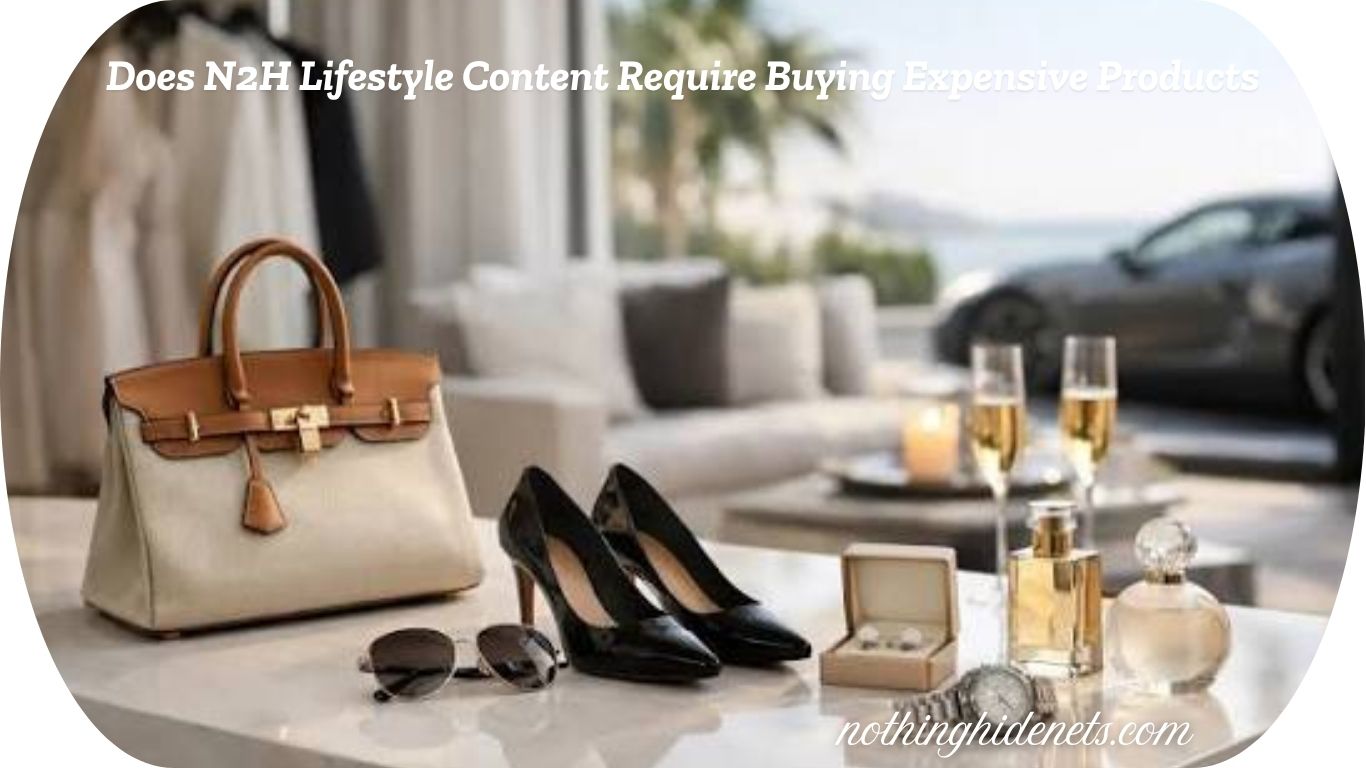
Does N2H Lifestyle Content Require Buying Expensive Products? A Complete Guide
People who search for “Does N2H lifestyle content require buying expensive products?” are often trying to understand whether lifestyle advice from N2H is mainly about shopping, premium products, or costly upgrades. This is a reasonable question because lifestyle content can sometimes include products, home improvements, technology, travel, health-related topics, and other areas where spending money may be involved.
Nothing2Hide.net presents itself as a broad content platform covering news, technology, gaming, and lifestyle insights. Its navigation includes a dedicated “Health & Lifestyle” section, alongside News, Tech, and Gaming.
Based on the publicly visible content, there is no general requirement that readers must buy expensive products to benefit from N2H lifestyle content. The site includes practical and informational subjects such as reading habits, senior care, home-related topics, travel privacy, nutrition, and everyday lifestyle issues.
That distinction is important. A lifestyle article can mention a product without making that product necessary. Readers can often use the underlying idea, habit, or recommendation without purchasing the most expensive option.
What Is N2H Lifestyle Content?
N2H lifestyle content generally refers to lifestyle-related material associated with Nothing2Hide.net. The website describes itself as a platform covering several areas, including news, technology, gaming, and lifestyle insights. Its main navigation specifically includes a “Health & Lifestyle” category.
Lifestyle content is a broad term. It can cover everyday decisions involving health, home, personal habits, travel, technology, hobbies, family life, and consumer choices.
This means readers should not automatically expect every N2H lifestyle article to be a shopping guide.
For example, a lifestyle article might discuss:
- Everyday habits
- Reading and personal development
- Home design
- Senior care
- Nutrition
- Travel considerations
- Personal routines
- Technology in daily life
- Health and wellness topics
- Privacy and safety
Publicly visible Nothing2Hide.net content includes articles about living well with books, caring for seniors at home, nutrition planning, home-related subjects, and travel privacy.
Some of these subjects may involve products or services, but the central value can still come from information rather than purchasing.

Does N2H Lifestyle Content Require Expensive Products?
No general evidence indicates that readers must buy expensive products to follow N2H lifestyle content.
This is the simplest answer to the main question.
A reader can usually approach lifestyle information as guidance rather than as a shopping requirement. If an article discusses a product, the reader should first identify what problem the product is supposed to solve.
For example, if a lifestyle article discusses improving a home environment, the underlying advice could involve organization, comfort, lighting, privacy, or design. A reader may be able to improve one of these areas using existing items or lower-cost alternatives.
The same principle applies to personal habits.
If an article encourages reading, better organization, or healthier routines, those activities do not automatically require expensive equipment.
The important distinction is between “this product may help” and “you must buy this product.”
Those are very different statements.
N2H lifestyle content should therefore be read for the information it provides, not as an automatic instruction to spend money.
Why Lifestyle Articles Sometimes Mention Products
Products naturally appear in lifestyle publishing because products are part of everyday life.
People buy furniture, clothing, kitchen equipment, fitness items, electronics, books, travel accessories, and home products. A lifestyle writer may mention these items simply because they relate to the subject.
For example, Nothing2Hide.net has publicly displayed content involving products and consumer-oriented subjects, including an article about headphones described in terms of sound quality and comfort.
The presence of a product in an article does not necessarily mean the product is required.
A product mention can serve several purposes:
- It can provide an example.
- It can explain a category of products.
- It can illustrate a lifestyle trend.
- It can help readers understand available options.
- It can describe a possible solution to a practical problem.
Readers should look at the actual purpose of the recommendation before deciding whether spending is necessary.
Are N2H Lifestyle Topics More About Information or Shopping?
The publicly visible structure of Nothing2Hide.net suggests that its lifestyle material is part of a larger informational publishing model rather than a single-purpose shopping site.
The website includes several broad sections, including News, Tech, Gaming, and Health & Lifestyle.
That matters because a shopping website usually has a different primary purpose. Its pages are generally designed around products, prices, specifications, stores, or purchases.
Lifestyle publishing can work differently.
An article may explain a subject first and only mention products as supporting examples. The reader can then decide whether a purchase is useful.
For U.S. readers, this distinction is especially useful because consumer products can vary greatly in price. A lifestyle suggestion that sounds simple can become expensive if someone assumes that only premium products are suitable.
Good consumer judgment means separating the advice from the item being discussed.
Can You Follow N2H Lifestyle Advice on a Budget?
Yes, many lifestyle ideas can be adapted to different budgets.
A practical lifestyle approach starts with the goal rather than the product.
Suppose the goal is to read more regularly. The reader does not necessarily need an expensive reading device. A library book, an existing paperback, or a free digital resource may accomplish the same basic goal.
Suppose the goal is to make a home more comfortable. A person might rearrange furniture, improve organization, change existing lighting, or reduce clutter before buying new products.
Suppose the goal is to improve daily routines. Planning, scheduling, walking, sleeping consistently, preparing meals, or reducing unnecessary digital distractions may involve little or no spending.
This does not mean products are never useful. Some products can provide genuine convenience or solve a real problem.
The key is that the lifestyle objective comes first.
What Is the Difference Between a Useful Product and a Luxury Upgrade?
A useful product solves a specific problem. A luxury upgrade may provide additional comfort, design, convenience, prestige, or performance.
Also Read: Can Matchmaking Guarantee That Every Online Game Will Be Fair?
Neither category is automatically good or bad.
Also Read: Does Nothing2hide Net Gaming Require Players to Be Competitive?
The important question is whether the additional cost provides enough value for the individual buyer.
For example, two products may perform the same basic task while having different prices. The more expensive model might have better materials, a longer warranty, additional features, or a stronger design.
That can make the higher-priced product appropriate for one person but unnecessary for another.
When reading N2H lifestyle content, readers can ask:
- What problem does this product solve?
- Is the product necessary?
- Is there an affordable alternative?
- Can I use something I already own?
- Does the extra cost provide a meaningful benefit?
- How often would I actually use it?
- Is the recommendation based on evidence or personal preference?
These questions make it easier to avoid unnecessary purchases.
Can Lifestyle Advice Be Useful Without Buying Anything?
Absolutely.
Some of the most practical lifestyle improvements involve behavior rather than products.
A person can improve certain areas of daily life through habits, planning, education, and awareness.
Examples include:
- Creating a simple daily schedule
- Reading regularly
- Spending more time outdoors
- Organizing an existing living space
- Learning a new skill
- Improving digital privacy habits
- Preparing meals at home
- Staying connected with family and friends
- Reviewing personal spending
- Reducing unnecessary screen time
These activities show why lifestyle content should not be interpreted as a list of products to purchase.
The value of an article can come from the information itself.
This is also important for people who are working with a limited household budget. A useful lifestyle resource should help readers understand choices rather than make them feel that a particular spending level is necessary.
How to Check a Product Recommendation Before Buying
Readers should evaluate recommendations using a few simple checks.
First, identify the claim.
Is the article saying that a product is essential, or simply that it is one possible option?
Second, consider the evidence.
Does the article explain why the product may be useful? Does it provide specific information about features, limitations, or use cases?
Third, compare alternatives.
A recommendation becomes easier to understand when readers compare several products at different price points.
Fourth, consider personal needs.
A product designed for frequent travelers may not be useful to someone who rarely travels. A premium kitchen appliance may not provide meaningful value to someone who rarely cooks.
Fifth, check the total cost.
The purchase price is not always the full cost. Accessories, subscriptions, maintenance, replacement parts, delivery, and upgrades can increase the real expense.
This approach is useful whether the article comes from N2H or any other lifestyle website.
Does a Higher Price Mean Better Lifestyle Results?
Not necessarily.
Price can reflect materials, branding, technology, design, durability, features, or other factors. It does not automatically prove that the product will produce better results for every user.
Consider a simple example.
Someone wants to develop a daily reading habit. A $300 device may offer advanced features, but if the person’s primary goal is simply to read, a library membership or inexpensive book may already meet the need.
The same principle applies to many lifestyle categories.
A premium product can be useful when its additional features solve a real problem. But if those features are rarely used, the extra cost may not provide much practical value.
This is why lifestyle decisions should be based on usefulness, frequency of use, personal priorities, and budget rather than price alone.
How to Set a Reasonable Lifestyle Budget
U.S. readers can approach lifestyle spending as part of their overall household budget rather than treating every recommendation separately.
A simple process is useful.
Start by identifying essential expenses such as housing, food, utilities, transportation, insurance, and other regular obligations.
Then consider discretionary spending.
Lifestyle purchases often fall into this category. Examples include upgraded electronics, décor, recreational equipment, premium clothing, travel accessories, and entertainment.
Before buying something recommended or mentioned in an article, ask whether the purchase fits comfortably within the available discretionary budget.
This prevents an interesting lifestyle idea from becoming an unnecessary financial burden.
It also helps separate needs from wants.
A product can be attractive and useful while still being optional.
Are Expensive Lifestyle Products Ever Worth Buying?
They can be, depending on the circumstances.
The question is not simply whether something is expensive. The better question is whether the product delivers enough value for its particular user.
A more expensive item may make sense when:
- It is used frequently.
- It replaces several other items.
- It has meaningful durability advantages.
- It saves significant time.
- It solves a specific problem.
- It has useful safety features.
- It comes with strong support or warranty coverage.
- Its additional features are genuinely needed.
On the other hand, paying more may not make sense when the extra features are rarely used or when a cheaper alternative performs the same essential function.
This is why N2H lifestyle content should not be interpreted as saying that expensive products are automatically better.
What to Check Before Buying a Product Mentioned by N2H
A careful buyer should do independent research before making a significant purchase.
The first step is to check the product’s official specifications.
Next, look for independent reviews from reputable sources. Do not rely on a single article or a single customer comment.
Compare prices from multiple retailers.
Also check:
- Warranty terms
- Return policy
- Shipping charges
- Subscription requirements
- Replacement costs
- Compatibility
- Product availability
- Customer support
- Long-term maintenance
This approach is particularly important for expensive purchases.
An article can introduce an idea, but the final purchasing decision should be based on the buyer’s own needs and additional research.
How Does N2H Lifestyle Content Fit Into Everyday Consumer Decisions?
Lifestyle content can be useful at the beginning of a decision-making process.
A reader might discover a new idea through an article and then research it further.
For example, an article about home comfort may introduce a type of product the reader has never considered. Instead of immediately buying it, the reader can investigate whether the problem actually exists, whether the product solves it, and whether there are simpler solutions.
This turns lifestyle content into a starting point for research rather than an automatic shopping list.
That distinction can make online reading more useful.
It also supports better digital literacy because readers learn to question claims, compare information, and check sources before spending money.
Can N2H Lifestyle Content Influence Consumer Spending?
Any lifestyle content that discusses products can potentially influence consumer behavior.
That is not unique to N2H. It is common across blogs, magazines, social media, video platforms, and online publications.
The influence may be direct or indirect.
A direct influence might be a product recommendation.
An indirect influence might be an article that makes a certain lifestyle appear desirable and causes readers to research products associated with it.
Readers can manage this influence by slowing down before purchasing.
A useful rule is the 24-hour pause for nonessential purchases. If the product is expensive, the waiting period can be longer.
During that time, ask whether the purchase still seems necessary.
This small habit can reduce impulse spending without preventing reasonable purchases.
What Are the Risks of Treating Lifestyle Content as Shopping Instructions?
The biggest risk is unnecessary spending.
Readers may assume that they need premium products when the underlying lifestyle goal could be achieved in another way.
Other risks include:
- Buying products that are rarely used
- Paying for unnecessary features
- Accumulating household clutter
- Taking on subscription costs
- Ignoring cheaper alternatives
- Relying on one source for purchasing decisions
- Confusing advertising with independent advice
There is also a broader digital literacy issue.
Not every recommendation online has the same level of evidence or editorial independence. A reader should understand who created the content, what claims are being made, and whether the information has been independently verified.
This is especially important when a purchase involves significant money.
How to Avoid Unnecessary Lifestyle Spending
A practical strategy is to separate the lifestyle goal from the shopping decision.
Instead of asking, “What should I buy?” start with:
Also Read: N2H Lifestyle Tips Blog by Nothing 2Hide: A Complete Guide to Better Daily Habits
“What am I trying to improve?”
Then consider the least expensive way to achieve that goal.
Also Read: What Type of Content Is Published on Nothing2Hide.net? A Complete Guide
For example, if the goal is better organization, try reorganizing existing possessions first.
If the goal is more physical activity, begin with accessible activities such as walking rather than assuming that expensive equipment is necessary.
If the goal is learning, consider libraries, free educational resources, community programs, and existing materials before purchasing expensive courses or devices.
If a product remains useful after these questions, it can then be evaluated on its own merits.
This method helps readers make intentional decisions rather than automatic purchases.
What About N2H Lifestyle Content That Discusses Health?
Health-related lifestyle content deserves additional caution.
Nothing2Hide.net’s visible Health & Lifestyle section includes subjects such as nutrition planning, senior care, hygiene, and other health-related topics.
Health decisions should not be reduced to product purchases.
For example, an article about nutrition does not mean that expensive supplements are necessary. An article about senior care does not mean that specialized equipment is required in every home.
Health needs differ from person to person.
When a topic involves symptoms, treatment, medication, serious medical conditions, or significant health decisions, readers should consult qualified healthcare professionals and reliable medical sources rather than relying only on general lifestyle articles.
This is an important part of responsible online reading.
Is N2H Lifestyle Content Suitable for Different Budgets?
Lifestyle information can generally be interpreted across different budgets because the underlying goals are often broader than the products associated with them.
A reader with a large budget may choose premium equipment or services.
Another reader may choose a lower-cost alternative.
A third reader may use existing items and spend nothing.
The same lifestyle principle can sometimes work across all three situations.
This is one reason readers should focus on the purpose behind a recommendation.
If an article discusses comfort, convenience, organization, health, learning, or personal development, ask what part of the recommendation is essential and what part is optional.
That distinction makes lifestyle advice more accessible.
Does N2H Lifestyle Content Focus on Expensive or Premium Products?
The available site structure does not support a simple conclusion that all N2H lifestyle content promotes luxury living.
The Health & Lifestyle section includes a mixture of subjects, while the wider website also covers technology, gaming, news, and other informational topics.
Some individual articles may naturally discuss products, services, or higher-cost experiences. That does not mean the entire category has a luxury focus.
Readers should evaluate each article based on its actual subject.
A piece about an expensive product is different from a general article about lifestyle habits.
The same applies to travel. A travel-related article may discuss a luxury experience, but that does not mean every reader needs to reproduce that experience to benefit from the information.
How Does Digital Literacy Help With N2H Lifestyle Content?
Digital literacy means understanding how to find, evaluate, and use online information responsibly.
This skill is particularly useful when reading lifestyle content because online information can combine education, opinion, product discussion, marketing, and entertainment.
A digitally literate reader does not automatically reject recommendations.
Instead, the reader asks questions.
Who published this?
What is the evidence?
Is the claim specific?
Are there limitations?
Is the product necessary?
Are there alternatives?
Can another reliable source confirm the information?
These habits help readers get more value from N2H lifestyle content while reducing the chance of making unnecessary purchases.
How to Evaluate Product Claims in N2H Lifestyle Content
Product claims should be treated carefully, especially when they involve performance, health, savings, durability, or major improvements.
A statement that a product is “better,” “more effective,” or “essential” needs context.
Better for whom?
More effective for what purpose?
Essential under which circumstances?
A careful reader should look for specific explanations rather than relying on broad promotional language.
This is important across the entire internet, not just N2H.
If a claim could influence a significant purchase, compare it with information from manufacturers, independent reviewers, consumer organizations, and other trustworthy sources where appropriate.
What Is the Best Way to Use N2H Lifestyle Content?
The most practical approach is to treat N2H lifestyle content as an information source rather than a mandatory shopping guide.
Start by understanding the topic.
Then identify the main problem or goal.
Next, separate general advice from product-specific recommendations.
After that, compare alternatives and consider your own budget.
For expensive purchases, conduct additional research before making a final decision.
This approach preserves the useful part of lifestyle publishing while reducing unnecessary spending.
It also gives readers greater control over their decisions.
Frequently Asked Questions
Can students use N2H lifestyle ideas without spending money?
Yes. Many lifestyle ideas can be adapted to a student budget. Reading, organization, time management, learning, digital safety, and healthy routines can often be practiced without buying expensive products. The specific requirements depend on the individual article and activity.
Should readers buy a product just because N2H discusses it?
No. A product mention should not automatically be treated as a purchasing instruction. Readers should understand why the product is mentioned, determine whether they actually need it, compare alternatives, and consider the total cost before buying.
Can N2H lifestyle content be used for family activities?
Some lifestyle topics may be useful for families, but suitability depends on the subject. Parents and caregivers should consider age, safety, individual needs, and the reliability of information before applying advice to children or other family members.
How can someone check whether an N2H lifestyle recommendation is trustworthy?
Compare the recommendation with reliable independent sources. Check product specifications, manufacturer information, reputable reviews, return policies, warranties, and other evidence. For health-related claims, use qualified healthcare professionals and established medical sources when appropriate.
Is expensive equipment necessary to follow lifestyle trends?
No. A lifestyle trend and the products associated with it are not always the same thing. People can often participate in a trend using existing items, lower-cost alternatives, or no new purchases at all. The right approach depends on the person’s goals, resources, and preferences.
Conclusion
So, does N2H lifestyle content require buying expensive products? Generally, no.
Nothing2Hide.net is a broad content platform with News, Tech, Gaming, and Health & Lifestyle sections. Its publicly visible lifestyle material covers a range of practical and informational subjects, including health, home, reading, senior care, and other everyday topics.
Some lifestyle articles can naturally mention products, services, or consumer choices. However, mentioning a product is different from requiring readers to purchase it.
The most useful way to approach N2H lifestyle content is to focus on the underlying goal. Ask what problem the article is discussing, what solution is being suggested, whether a purchase is actually necessary, and whether a cheaper alternative could provide similar value.
This approach is especially practical because household budgets and lifestyle needs vary widely. A product that makes sense for one person may be unnecessary for another.
Ultimately, lifestyle content is most useful when it helps readers understand their options. Expensive products can sometimes provide real benefits, but price alone does not determine whether something is necessary or worthwhile. Careful research, budget awareness, comparison shopping, and digital literacy can help readers use N2H lifestyle information without turning every recommendation into an expensive purchase.